

METALS
Pure (24 carat) gold is a deep yellow colour (an orange shade of yellow) and is soft and very malleable. The coloured carat gold alloys range in gold content from 8 to 22 carats (33.3% - 91.6% gold) and can be obtained in a range of colour shades: green (actually a green shade of yellow), pale yellow, yellow, deep yellow, pink/rose and red. There are also white golds and even unusual coloured golds such as ‘purple gold’. They all have different mechanical properties such as strength, hardness and malleability (ductility) and some alloys can be heat treated to maximise strength and hardness. There are gold alloys that are optimised for different manufacturing routes such as lost wax (investment) casting and stamping.
How can colour be varied and why do different gold alloys (an alloy is a mixture of two or more pure metals) have different mechanical and other properties? To answer these questions in depth requires a good technical knowledge of metallurgy. However, it is possible to give some simplified answers.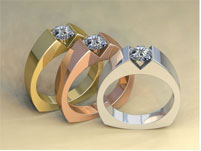 The Coloured Carat Golds:
Almost all conventional, coloured carat golds are based on gold-silver-copper alloys, often with minor alloying additions. All three metals have the same crystal structure (face centred cubic, FCC) and so are compatible with each other over a large range of compositions. Typical minor additions include deoxidisers such as zinc and silicon, grain refiners such as iridium and cobalt and possibly metals such as nickel to strengthen the alloy. Larger zinc additions (about 1-2%) can improve melt fluidity and hence ‘castability’ in lost wax casting, as can silicon, resulting in better filling of the mould and better reproduction of surface detail. Even larger zinc additions (up to 10%) can improve malleability of certain carat golds, particularly 14 carat and lower, used for making jewellery by stamping from sheet. Additions of low melting point metals such as zinc, tin, cadmium and indium lower melting ranges and hence are used to make carat gold solders.
Colour:
Gold is yellow and copper is red, the only two coloured pure metals. All other metals are white or grey in colour. The addition of a red colour to yellow, as every school child knows, makes the yellow pinker and eventually red. The addition of a white makes the yellow colour paler and eventually white. This principle of mixing colours is the same in carat golds. Adding copper to gold makes it redder and adding silver, zinc and any other metal makes gold paler. Thus, we can understand that lower carat golds, because we can add more alloying metals, can have a wider range of colours than the higher carat golds.
Thus at 22 carat (91.6% gold), we can only add a maximum of 8.4% of alloying metals and hence can only obtain yellow to pink/rose shades. At 18 carat (75.0% gold) and lower, we can add 25% or more alloying metals and hence get colours ranging from green through yellow to red, depending on the copper: silver plus zinc ratio. Thus at any given caratage we can vary the colour by varying the copper: silver plus zinc ratio.
White golds:
Apart from copper, all other alloying metals to gold will tend to whiten the colour and so it is possible to make carat golds that are white in colour. White golds for jewellery were developed in the 1920’s as a substitute for platinum.
Additions of any white metal to gold will tend to bleach it’s colour. In practice, nickel and palladium (and platinum) are strong ‘bleachers ‘ of gold; silver and zinc are moderate bleachers and all others are moderate to weak in effect.
This has given rise to 2 basic classes of white golds - the Nickel whites and the Palladium whites. At the 9 carat (37.5% gold) level, a gold-silver alloy is quite white, ductile although soft and is used for jewellery purposes. White golds are available up to 21 carat.
There is no legal definition of what constitutes a ‘white’ colour in golds and hence trade description of white gold may not mean ‘detergent white’. Many commercial white golds are not a good white colour.
Palladium white golds:
Additions of about 10 -12% palladium to gold impart a good white colour. But palladium is an expensive metal, dearer than gold and it is also a heavy metal. Thus jewellery in such palladium white golds will be more expensive than identical pieces in nickel whites for 2 reasons: firstly, the cost of the palladium and secondly, the impact of density - palladium white golds are denser and so such jewellery will be heavier and also contain more gold. It is also more difficult to process as the melting temperatures are substantially higher.
Many commercial palladium white golds only contain about 6-8% palladium plus silver, zinc and copper. Some may even contain some nickel [so a palladium white gold is not necessarily nickel-free]. These may also have less than a good white colour and so may also be rhodium plated.
Palladium white golds tend to be softer and more ductile compared to nickel whites and so will not wear as well. They are available in all caratages up to 21 carat. It is not possible to have a 22 ct white gold, for example.
DIAMOND INFORMATION
The 4 C’s – Carat, Colour, Clarity and Cut
Diamond Carat Weight
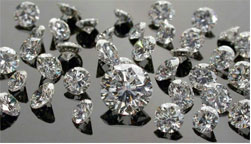
Although commonly thought to refer to the actual size of a diamond, a carat is actually a standard unit of measure that defines the weight of a diamond. One carat is equivalent to 200 milligrams. Carat sizes are also expressed as “points”, with a one carat diamond equaling 100 points, a one-half carat diamond being 50 points, a three-quarter carat diamond being 75 points, and so on.
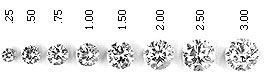
Larger diamonds are much rarer than smaller ones. In fact, hundreds of tons of rock and ore must be processed to uncover a single one-carat gem quality diamond, and less than one percent of all women will ever own a one- carat or larger diamond.
Since a carat is a unit of measure and not size, two diamonds of the same carat weight may appear to be different sizes depending on how the diamond is cut. Some diamonds will have extra weight on the bottom part — or pavilion — of the stone, and therefore appear smaller. A premium cut diamond is perfectly cut, and will appear larger than many diamonds of a heavier carat weight.
Diamond Colour:
Although most people believe diamonds to be clear or colorless, the majority of diamonds are yellow, brown, and black. Most of those diamonds find their way into industrial purposes, (drill bits, saw blades, etc.) The rarest of all diamond colors are white (or colorless).
Diamonds are graded for color face down, against a white background. Graders are looking at the actual body tone (hue) of the stone and comparing it to a set of master stones. The diamond is then assigned a letter grade as seen on the accompanying chart. Most diamonds used for jewelry purposes fall into the Near Colorless Category - G to J.

Perhaps the most important factor to consider when selecting color is the type of setting you plan on using. If you plan on mounting the stone on a platinum or white gold setting, consider a diamond in the D-G range. Yellow gold will be much more forgiving to a less than colorless stone, but regardless of the setting, the diamond will start to appear yellow if the color grade is lower than about J.
Diamond Clarity:
A diamond’s clarity refers to the presence of identifying characteristics on and within the diamond. While most of these clarity characteristics are inherent qualities of the rough diamond and have been present since the earliest stages of the diamond crystal’s growth below ground, a few clarity flaws are actually a result of the harsh stress that a diamond undergoes during the cutting process itself.
If you think about the incredible amount of pressure it takes to create a diamond, it’s no surprise that many diamonds have clarity inclusions — scratches, blemishes, air bubbles or non-diamond mineral material — on their surface or inside. Diamonds with no or few inclusions and blemishes are more highly valued than those with less clarity, not just because they are more pleasing to the eye, but also because they are very rare.
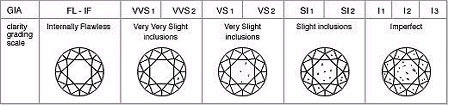
Diamonds are graded for clarity under 10x loupe magnification. Clarity grades range from Internally Flawless, diamonds which are completely free of blemishes and inclusions even under 10x magnification, to Imperfect 3, diamonds which possess large, heavy blemishes and inclusions that are visible to the naked eye.
FL: Completely flawless
IF: Internally flawless; only external flaws are present, which can be removed by further polishing the stone
VVS1 - VVS2: Only an expert can detect flaws with a 10X microscope. By definition, if an expert can see a flaw from the top of the diamond, it is a VVS2. Otherwise, if an expert can only detect flaws when viewing the bottom of the stone, then it is a VVS1
VS1 - VS2: You can see flaws with a 10X microscope, but it takes a long time (more than about 10 seconds)
SI1 - SI2: You can see flaws with a 10X microscope
I1 - I3: You can see flaws with the naked eye. Consider avoiding I2-I3 diamonds.
Diamond Cut:
First, don’t confuse diamond “cut” with “shape.” Shape refers to the general outward appearance of the diamond, (such as round, emerald, or pear). When a diamond jeweller (or a diamond certificate) says “cut,” that’s a reference to the diamond’s reflective qualities, not the shape.
Diamond cut is perhaps the most important of the four Cs, so it is important to understand how this quality affects the properties and values of a diamond. A good cut gives a diamond its brilliance, which is that brightness that seems to come from the very heart of a diamond. The angles and finish of any diamond are what determine its ability to handle light, which leads to brilliance.
When a diamond is well-cut, light enters through the table and travels to the pavilion where it reflects from one side to the other before reflecting back out of the diamond through the table and to the observer’s eye. This light is the brilliance we mentioned, and it’s this flashing, fiery effect that makes diamonds so mesmerizing.
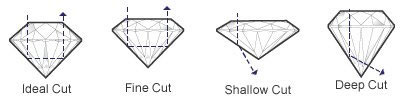
It’s easy to see that the deep-cut diamond shown above will have a higher carat weight, but is clearly the less desirable stone! Many jewelers will not discuss cut proportions unless the customer specifically asks; a stone rich in carat weight but poorly proportioned can be deeply “discounted,” giving the buyer a false impression of a great deal.
In a poorly cut diamond, the light that enters through the table reaches the facets and then ‘leaks’ out from the sides or bottom of the diamond rather than reflecting back to the eye. Less light reflected back to the eye means less brilliance.
